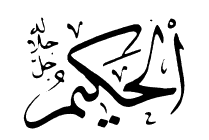
we declare Your Perfection above and beyond all: we have no knowledge whatsoever except what You have taught us. No doubt it is You, and You alone that is all Knowledgeable and all Wise. (al-Baqarah, 32)

Saturday, February 18, 2012

Allah SWT's advice to Musa AS


Surah TaHa is a powerful surah that is literally filled with gems of wisdom. It is the surah that changed the heart of Umar Ibn Al-Khattab from being a vicious hater of the Muslims into one of world's best. But perhaps the one aya that strucks me the most is aya 44, where Allah SWT says:


فَقُولَا لَهُ قَوْلًا لَيِّنًا لَعَلَّهُ يَتَذَكَّرُ أَوْ يَخْشَىٰ


And speak to him gently so that he may take reminder or become *'khashiya'

These are Allah's words towards Musa AS when He ordered him to go to firaun (the pharaoh). It's truly incredible. Musa, the prophet, is told to give reminder to firaun, a man who had ordered the execution of all of Bani Israel's male children every other year, a man who wants Musa AS dead, a man who has the audacity to claim himself a god, a man who could easily be called the worst man who had ever lived the earth.

And still Allah SWT reminds Musa AS to speak to him gently.

SubhanAllah this got me thinking, if a man as bad as firaun deserves to be spoken gently to, how much more deserving do our children, our students, our friends or even our leaders do? This is a very simple yet powerful advice from Allah SWT. Let's try to incorporate it into our speech whenever we are giving advice or dakwah to others. And if we happen to talk to someone we really abhore, remember: that person can't be much worse than firaun.

Wallahua'lam.


*'Khashiya' is usually translated as fear. However, according to br. Nouman Ali Khan, that is a very shallow translation as there are 12 different words in the Quran that are translated as fear. The words 'khauf' and 'taqwa' for example, a also both translated as fear. 'Khashiya' does mean fear, but it's a very specific type of fear. It is a fear of something magnanimous, that simply being in it's presence makes us humbled.

Saturday, December 10, 2011

Clearing Misconceptions About Adam AS


Why are we stuck on earth?

Depending on one's religious belief (or one's lack of it thereof), you'll get different answers. I can't really say for every other religious belief, but I do believe that for most of the people of the Abrahamic faiths (Muslims, Christians and Jews), their answer would be because the first man created by God Almighty defied His command by eating from a forbidden tree and was thus banished to the Earth and his wife Eve (we Muslims call her Hawa) along with him.

If I didn't know better, that would've probably been my answer as well. However, a study of the Quran reveals  that that's not entirely true.

You see, according to the Quran, Allah SWT has already decided before Adam AS ('alaihissalam - peace be upon him) was created, that he was to be placed on earth.

وَإِذْ قَالَ رَبُّكَ لِلْمَلَائِكَةِ إِنِّي جَاعِلٌ فِي الْأَرْضِ خَلِيفَة
And (remember) when your Lord  said to the angels, "Verily, I will create a *khalifah on earth" (Al-Baqarah, 2:30)

This might raise a particular question: if God really intended for Adam AS to be placed on earth, why was he put in Paradise in the first place? That is a very valid question; one that the Allah SWT did not forget to address in His Book:

وَقُلْنَا يَا آدَمُ اسْكُنْ أَنْتَ وَزَوْجُكَ الْجَنَّةَ وَكُلَا مِنْهَا رَغَدًا
 حَيْثُ شِئْتُمَا وَلَا تَقْرَبَا هَٰذِهِ الشَّجَرَةَ فَتَكُونَا مِنَ الظَّالِمِينَ
We said: "O Adam! Dwell you and your wife in Jannah (Garden / Paradise); and eat of the bountiful things therein as (where and when) you will; but approach not this tree, or you run into harm and transgression." (Al-Baqarah, 2:35)

The Arabic Language has a few words that means 'to live 'or 'to dwell', the most common of which is 'khuld'. For instance when in the following ayah, which describes the people who will live forever in Paradise, the word 'khaalidiin' which is a derivative of the word 'khuld' is used:


جَزَاؤُهُمْ عِنْدَ رَبِّهِمْ جَنَّاتُ عَدْنٍ تَجْرِي مِنْ تَحْتِهَا الْأَنْهَارُ خَالِدِينَ
فِيهَا أَبَدًا ۖ رَضِيَ اللَّهُ عَنْهُمْ وَرَضُوا عَنْهُ ۚ ذَٰلِكَ لِمَنْ خَشِيَ رَبَّهُ
Their reward is with Allah: Gardens of Eternity beneath which rivers flow; they will dwell therein for ever; Allah well pleased with them and they with Him: all this for such as fear their Lord and Cherisher. (Al-Bayyinah, 98: 8)

However, the word used in the aforementioned ayah isn't 'khuld' but 'uskun' ."Uskun' comes from the root word 'sukun' which means something that was in motion but stops temporarily and will afterwards continue to move (those of you who remember your tajweed should be familiar with this word). By using this word in the ayah, Allah SWT is telling Adam AS - and by extension, us- that his place in Paradise was only temporary and that he will have to move to his actual abode, earth, sooner or later. You can think of it as a transit before the final destination. Had it been a permanent stay, the word that would be the most appropriate to use is 'ukhlud' and not 'uskun' which, as mentioned above, implies the meaning of it being temporary.

Adam AS himself understood this and was aware that they won't be staying in Paradise forever, and Iblis - the Devil - used this knowledge to tempt Adam AS and Hawa into eating from the forbidden tree
وَقَالَ مَا نَهَاكُمَا رَبُّكُمَا عَنْ هَٰذِهِ الشَّجَرَةِ إِلَّا أَنْ تَكُونَا
مَلَكَيْنِ أَوْ تَكُونَا مِنَ الْخَالِدِينَ
he (satan) said, "Your Lord forbade you this tree lest you should become angels or such beings as live for ever." (Al-A'raf, 7:20)


Another common misunderstanding about this story is that Adam AS and Hawa was banished to earth because of their sin of disobeying the Lord and eating from the tree. This, however, isn't the real reason because Allah SWT clearly says in the narrative in surah Al-Baqarah that He had accepted their repentance.

فَتَلَقَّىٰ آدَمُ مِنْ رَبِّهِ كَلِمَاتٍ فَتَابَ عَلَيْهِ ۚ إِنَّهُ هُوَ التَّوَّابُ الرَّحِيمُ
Then learnt Adam from his Lord words of inspiration and his Lord turned toward him (accepting his repentance); for He is Oft-Returning, Most Merciful. (al-Baqarah, 2: 37)

If they were forgiven, it wouldn't make much sense for them to be banished to earth as a punishment wouldn't it?

This further enforces the notion that neither Adam AS nor his spouse are to be blamed for the human race to be put on earth. This is clearly a misconception that needs to be set straight especially among the Muslims. We must realize that our place on earth is a matter that has always been decided. It is only after we have proven ourselves worthy of Paradise in this world that we will be allowed to live there in the hereafter.

Wallahua'lam - Allah knows best.


*  *  *  *  *  *  *  *
*Khalifah is an Arabic word literally meaning "one who replaces someone else who left or died" (taken from http://islamic-world.net/khalifah/definition.htm)


**image taken from http://socialtimes.com

Wednesday, October 19, 2011

Love Others as You Love Yourself


Out of the many ahadeeth (sayings of the Prophet Muhammad s.a.w) that I memorised way back when I was in high school, one of them sticks clearly in my mind for some reason or another. The hadeeth goes:

None of you will truly believe until you love for your brother what you love for yourself”. (Al-Bukhari)

It's a fairly straightforward and easily understood hadeeth, but it was only recently after hearing a story of one particular great individual that I understood it in a new light.

The story is of of Imam an-Nawawi r.a. He was one of the greatest zahid of his time, which meant he doesn't own much worldly materials. One night as he was praying, a thief broke into his house. Seeing as there wasn't much (if any) to be taken, the thief decided to take the only he could found of value - an-Nawawi's shoes. After finishing his solah, an-Nawawi who realised a thief had entered his house started running outside chasing after the thief shouting.

What exactly did he shouted? If any normal person would be in his shoes, I think it would be something along the lines of "Stop! Thief" though honestly, that is probably putting it mildly.

An-Nawawi said nothing like that at all. Instead, he was shouting to the thief to accept his shoes as a gift! Why? Because he was a man who truly had taqwa. As much as he fears to be punished by Allah and be entered to the hellfire for committing sins, he also fears other to fall into sin. SubhanAllah, just look at the level of iman this man had! Now this is how a person truly loves his brother. This is how we should be loving our brothers.

I pray that we can inculcate even just a fraction of this attitude shown by Imam an-Nawawi into our lives

Wallahua'lam.

Wednesday, September 28, 2011

Allah Knows What Is Best


One of the names of Allah s.w.t is al-Hakeem - the Most Wise - and part of His wisdom is manifested in the Divine Laws that He imparts to us through the Quran. In fact in surah YaaSiin (among other places), He even says that the Quran itself is wisdom.

As Muslims, we must believe that there is wisdom in each and every command that Allah gave us in the Quran, from issues like, say, the prohibition of riba (usury), the need to cover one's 'aurah, fasting, the five daily prayers and the list goes on. Basically, everything that Allah commands us to do has wisdom in it and is for our own good.

However, there are people in the post-modern society that we live in today who start to second guess the Laws of Allah, claiming it no longer relevant and is inappropriate for the 'modern' society. Some even say it's barbaric! Astaghfirullah, may Allah have mercy on them. This is because in these people's minds, they fail to see the logic - and by extension, the wisdom - behind these Laws.

What does Allah s.w.t has to say about this? In the Quran, He says:

وَلَوْ أَنَّا كَتَبْنَا عَلَيْهِمْ أَنِ اقْتُلُوا أَنفُسَكُمْ أَوِ اخْرُجُوا مِن دِيَارِكُم مَّا فَعَلُوهُ إِلَّا قَلِيلٌ مِّنْهُمْ وَلَوْ أَنَّهُمْ فَعَلُوا مَا يُوعَظُونَ بِهِ لَكَانَ خَيْرًا لَّهُمْ وَأَشَدَّ تَثْبِيتًا
If We had prescribed upon them to kill themselves or to leave their homes, very few would have done it: But if they had done what they were advised to do, it would have certainly been best for them, and would have gone farthest to strengthen (their faith) [Surah an-Nisa', 4:66]

Think about the above aya for a bit. It says "to kill themselves or to leave their houses". What logic is there in such commands? If anything, the logical mind would say that it is madness. Of course, Allah didn't command any of these to us, He was just proving a point, that is; "if We had prescribed upon them... it would have certainly been best for them". 

In this aya, we learn that there are times when our limited intellect are just unable to grasp the logic behind certain things that Allah reveals to us. We may not understand it or even see the wisdom behind it, but know for sure that it is definitely, definitely better for us. Why? Because Allah is al-Hakeem, He is the Most Wise and He knows what is best. And that answer should be enough for us if we truly believe in Him.

May Allah give us the correct understanding of His Deen and the Quran, and may Allah guide us to and along the straight path.

Wallahua'lam


Thursday, September 22, 2011

Allah, Our Rabb


In this post, I'd like to share a reflection on the following two ayaat from the Quran which sums up the reality of our current ummah very well:

وَلَئِن سَأَلْتَهُم مَّنْ خَلَقَ السَّمَاوَاتِ وَالْأَرْضَ وَسَخَّرَ الشَّمْسَ وَالْقَمَرَ لَيَقُولُنَّ اللَّهُ 
If indeed thou ask them who has created the heavens and the earth and subjected the sun and the moon (to his Law), they will certainly reply, "Allah". (Surah al-Ankaboot, 29: 61)

قُلْ مَن رَّبُّ السَّمَاوَاتِ وَالْأَرْضِ قُلِ اللَّهُ 
Say: "Who is the Rabb of the heavens and the earth?" Say: "(It is) Allah." (Surah ar-Ra'ad, 13: 61)

In the aya from surah al-Ankaboot, the question asked was 'who is the Creator' and the people have no problems in declaring that Allah is the Creator of everything. In the aya from Surah ar-Ra'ad however, the question asked was 'who is the Rabb' and interestingly, to this question we don't find the people declaring an answer. Instead we find Allah s.w.t commanding his Messenger s.a.w to tell the people that Allah is indeed the Rabb of the heavens and the earth.

To fully appreciate this aya, we must first understand what Rabb means. Rabb essentially means 'One who has absolute ownership, right and authority'. Actually, this is the concept that is at heart of our relationship with Allah and we can see this in surah TaHa, when Allah first introduced Himself to Musa a.s and said:

إِنِّي أَنَا رَبُّكَ فَاخْلَعْ نَعْلَيْكَ إِنَّكَ بِالْوَادِ الْمُقَدَّسِ طُوًى
Veryl it is I, I am your Rabb therefore take off your shoes; you are in the sanctified valley of Tuwa (Surah TaHa, 20: 12)

Meanwhile in surah al-Alaq which is the first revelation to Prophet Muhammad s.a.w, he was told: 

اقْرَأْ بِاسْمِ رَبِّكَ الَّذِي خَلَقَ
Read! In the name of your Rabb who created. (Surah al-Alaq, 96: 1)

In both instances, Allah is being introduced to a Prophet and the very first thing that these Prophets were told about Allah is that He is the Rabb - He has complete authority. He even goes further to display His authority to the Prophets by giving them each a command in the very same aya in which He is introduced. To Musa a.s He says, "take off your shoes" and Muhammad s.a.w was told, "read!". 

In these ayaat is a summary of our relationship with Allah, our Rabb. He has absolute ownership, right and authority over us. Therefore He has all the rights in the world to tell us what He wants us to do or not do and our responsibility to Him in turn is to obey His commands.

Now that we have established how heavy and important this word is, we should be able to understand the ayaat from surah al-Ankaboot and ar-Ra'ad in a different light. 

وَلَئِن سَأَلْتَهُم مَّنْ خَلَقَ السَّمَاوَاتِ وَالْأَرْضَ وَسَخَّرَ الشَّمْسَ وَالْقَمَرَ لَيَقُولُنَّ اللَّهُ 
If indeed thou ask them who has created the heavens and the earth and subjected the sun and the moon (to his Law), they will certainly reply, "Allah". (Surah al-Ankaboot, 29: 61)

قُلْ مَن رَّبُّ السَّمَاوَاتِ وَالْأَرْضِ قُلِ اللَّهُ 
Say: "Who is the Rabb of the heavens and the earth?" Say: "(It is) Allah." (Surah ar-Ra'ad, 13: 61)

These  ayaat exposes what is going on in the minds of people who readily admits that Allah is their Creator but are unable to accept that Allah is their Rabb. These are people who have problems accepting Allah as having absolute authority over their life. These are people who claim to be Islam but still refuse to obey certain commands of Allah - be it to pray or fast or pay the zakat or concerning their 'aurah.

Unfortunately, this is the state of a large majority of the Muslims among us today are in. People who know very well that Allah is their creator but are utterly heedless in the fact that above and beyond simply being our Creator, He is also our Rabb. And this is a sad reality that we can clearly see going on around us.

And you know what the really scary thing is? It is that the the first question that one is asked in the grave according to the narration of the Prophet s.a.w is "who is you Rabb". Know that simply acknowledging Allah as the God who created us isn't enough to save us on that day. If we do not accept Allah as our Rabb today, how can we expect ourselves to be able to answer that question when on that day?

Wallahua'lam.

 
Related Posts with Thumbnails